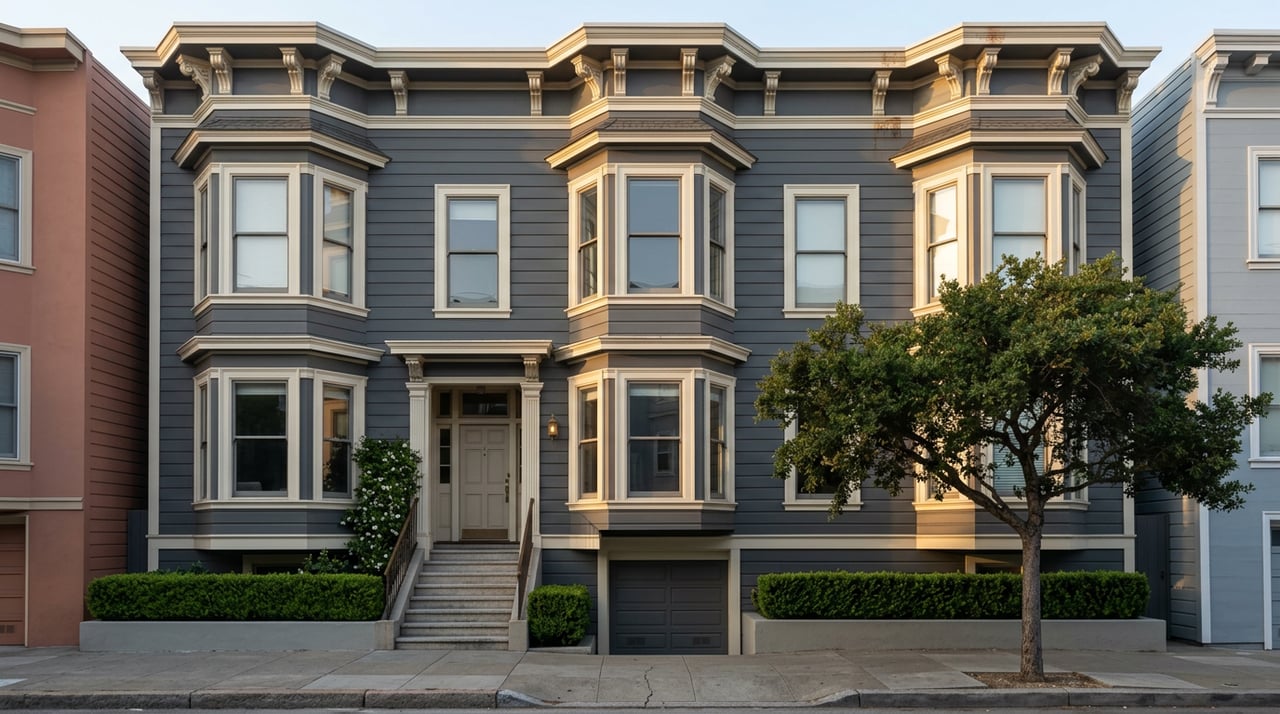
A buyer touring Pacific Heights this year will eventually hit the same wall. Two flats, same block, same vintage bay windows, same walk to Alta Plaza Park. One is listed as a condo. The other, priced meaningfully lower, is a TIC. The listing agent explains it as fractional ownership versus fee simple title, which is true but doesn't answer the question a buyer actually has: is this discount a bargain that closes once the building converts, or is it pricing something that isn't going away?
The honest answer, based on where San Francisco's conversion rules actually stand in 2026, is the second one. And the reason has less to do with paperwork than with the specific kind of building Pacific Heights is full of.
The Discount Isn't About the Unit
A condo owner holds a grant deed to a specific air-space parcel, its own tax bill, and access to any conventional or jumbo lender in the country. A TIC owner holds a fractional percentage of the entire building, with a private agreement assigning exclusive use of one unit. The distinction sounds legalistic until it hits financing. TIC buyers work with a small pool of lenders who understand fractional loans, and even in 2026, with more fixed-rate TIC products on the market than a few years ago, those loans typically carry rates half a point to a full point above standard condo financing.
That narrower lender pool is why the price gap exists at all. It isn't a discount for a worse location or a smaller kitchen. It's compensation for a smaller, more specialized group of people who can finance the purchase.
A Program That Keeps Missing Its Own Deadline
San Francisco's condominium conversion restrictions trace directly back to Pacific Heights. The city tightened its rules in 1981 as a reaction to a wave of large-building conversions in 1979 and 1980 that displaced long-term tenants in Nob Hill, Russian Hill, and Pacific Heights specifically. The policy response was to cap eligible buildings at six units or fewer and to slow the pace of conversions everywhere.
The mechanism for doing that slowing has been broken for over a decade. San Francisco suspended its old numeric lottery in 2013 and replaced it with the Expedited Conversion Program, which required owners to offer binding lifetime leases to any non-owner tenants. A federal lawsuit filed in June 2017 challenged that lifetime lease requirement and brought most of the program to a halt within four years of its creation. By 2020 the program was effectively wound down, with a return expected by 2024, then 2025, then 2026. As of the most recent legal updates tracking the program this year, that return still hasn't happened, with no confirmed relaunch date on the calendar.
That means anyone buying into a three, four, five, or six-unit Pacific Heights building this year, expecting the lottery to eventually clear a path to individual title, is planning around a program that has now missed three separate self-imposed deadlines. A fuller breakdown of how San Francisco's conversion eligibility rules actually work is worth reading before anyone treats a TIC purchase as a temporary arrangement.
The One Path That Still Works, and Why It Rarely Fits This Neighborhood
There is a conversion route that doesn't depend on the city reopening anything. Under the two-unit bypass, a building where both owners have occupied their exclusive-use units as their primary residences for twelve consecutive months can apply for condo conversion administratively, with no lottery and no annual cap. It's the one part of the system that behaves predictably.
The problem is that the same history responsible for the 1981 crackdown also describes the housing stock the crackdown was reacting to. Pacific Heights was built out with large Victorian and Edwardian buildings, many of them subdivided into three, four, or six units over the decades, not duplexes. A block over from a TIC, a buyer might find a building like 2445-2457 Buchanan Street, offered as three separate condominium titles under one ownership. That's what a completed conversion looks like. But it's the exception in this neighborhood's building stock, not the rule, because the bypass simply doesn't apply to a building with three or more units regardless of how long the owners have lived there.
What the Discount Is Actually Pricing
| Condominium | TIC | |
|---|---|---|
| Title | Individual fee simple parcel | Fractional interest in the whole building |
| Financing | Any conventional or jumbo lender | Small pool of fractional-loan lenders |
| Typical rate difference | Baseline | Roughly 0.5 to 1 percentage point higher |
| Buyer pool at resale | Broad, including FHA/VA-eligible buyers where the building qualifies | Narrower, mostly cash-flexible owner-occupants |
| Price gap vs. comparable unit | Baseline | Recent 2026 estimates range from single digits to roughly 30 percent, with the gap tending to widen as price points climb, since fewer specialized lenders are willing to underwrite larger fractional loans |
| Path to individual title | Already achieved | Two-unit bypass, if the building qualifies, or a lottery that remains suspended |
The Eviction Clock Nobody Mentions Until the Inspection Period
A building's conversion eligibility can be permanently damaged by something that happened years before a buyer ever toured it. A no-fault eviction, whether for owner move-in, relative occupancy, renovation, or an Ellis Act filing, generally locks a building out of conversion for roughly a decade under current rules. A buyout involving an elderly, disabled, or catastrophically ill tenant disqualifies the building outright, with no waiting period that clears it. A buyout of tenants who don't fall into those protected categories still extends the required owner-occupancy period substantially. None of this shows up on a listing flyer.
Before writing an offer on a Pacific Heights TIC, it's worth asking the seller directly:
- Has this building had a no-fault eviction or a reported tenant buyout, and when?
- Have any units sat vacant for an extended period? Vacant units don't count toward owner-occupancy requirements.
- Is the building subject to San Francisco's mandatory soft-story retrofit program, and has that seismic work been completed? Outstanding retrofit violations can block a conversion application even after a building otherwise qualifies. Status can be checked directly through the Department of Building Inspection.
- What does the current TIC agreement say about resale approval, financing requirements, and rent if any unit is tenant-occupied?
- Which lenders have financed units in this specific building before? A building with an established financing track record is easier to buy into and easier to sell later.
Why the Math Still Works in This Market
None of this makes a Pacific Heights TIC a bad purchase. It makes it a different one than the condo down the block, and pricing it correctly requires understanding what the discount compensates for rather than assuming it's a placeholder price waiting for conversion to catch up.
The context that makes this worth working through right now is how tight the top of the Pacific Heights market has gotten. A 149-year-old Queen Anne Victorian at 2315 Broadway sold in an all-cash deal that closed at roughly $25 million once commission and transfer tax were factored in, part of a broader run of luxury sales the Real Deal reported as AI-driven wealth reshapes competition for the city's scarcest properties. Condos in this kind of market routinely draw double-digit competing offers. A properly vetted TIC, priced honestly against its real financing constraints rather than a hoped-for conversion, remains one of the few ways into this neighborhood's housing stock without stepping into that bidding war.
A Few Questions Worth Asking Before You Sign
Will San Francisco's condo lottery ever reopen? It has missed its 2024 and 2025 targets and current updates now frame 2026 as the window, but no relaunch date has followed the earlier misses. The safest planning assumption for a multi-unit Pacific Heights building is that no lottery exists until one actually reopens.
Does buying a TIC hurt resale later? Not inherently. It shifts the buyer pool at resale toward people comfortable with fractional financing, which is a smaller group than the condo market but not a nonexistent one. Pricing and marketing should reflect that narrower, more patient audience.
What if the building already qualifies for the two-unit bypass? Then the calculation changes, since the bypass runs on an administrative timeline rather than a lottery. Confirming both owners' twelve-month occupancy history and a clean eviction record before making an offer is worth the extra week it takes.
Reading a Pacific Heights TIC listing correctly means treating the price gap as a fact about financing and building eligibility, not a temporary discount on a condo you haven't received yet. If you're weighing a TIC against a comparable condo in this neighborhood, David Poulsen can walk through a specific building's conversion history and financing options before you write an offer. Schedule a free consultation to talk through what a particular Pacific Heights building actually qualifies for.